
Blog
5 Snyk Alternatives for DevSecOps Teams (2026)

You’re leading DevSecOps, and the board expects vulnerabilities under 50 by Q3. Choose the wrong tool, and you’ll drown in 10,000 false positives. Alerts get ignored, and you miss the deadline.
Snyk is solid for many, but its pricing and alert fatigue don’t suit everyone. We skipped the noisy “alternatives” lists and only compared true competitors with comparable scanning breadth and integrations.
We evaluated Snyk alternatives on four criteria: unified SAST, SCA, and container scanning capabilities; developer-friendly integration and remediation workflows; runtime or active threat detection beyond passive scanning; and transparent pricing with broad language support.
The 5 firms we reviewed span modern DevSecOps-first designs, SBOM-powered supply chain tools, and runtime security platforms that detect threats in production, not just at build time.
Why Teams Are Looking Beyond Snyk
Snyk is still popular, but it doesn’t work for every team. As security programs grow and mature, many organizations start searching for alternatives that offer broader coverage, better runtime visibility, stronger compliance support, or simply more predictable pricing.
On top of that, tool sprawl makes things even harder. Security teams need more than just dependency scanning these days. They’re looking for cloud security, container protection, runtime defense, supply chain tools, and solid compliance features—all in one place or as specialized solutions that fit their workflow.
The Snyk alternatives we’ve reviewed each tackle these challenges in their own way. Some provide a full DevSecOps platform, others zero in on supply chain security, and a few shine at runtime intelligence that flags real risks in production.
Top Snyk Alternatives Worth Considering
The five Snyk platforms listed below are the most practical choices for teams looking to balance security coverage, operational complexity, and affordability. Each was chosen based on real-world usage and unique market positioning, ranging from all-in-one DevSecOps consolidation to open-source SAST and runtime threat detection.
Opengrep
Opengrep is a community-driven open-source fork supported by over 10 organizations. It removes the feature-gating found in most commercial SAST tools — every important capability, from inter-procedural analysis to advanced taint tracking, is available in the free core.
Teams frustrated with stripped-down “community” versions will appreciate the complete package. It also brings better language coverage and Windows support.
On the flip side, community-powered integrations can be less refined, and you won’t get vendor-managed updates or enterprise SLAs. It works best for teams with solid internal DevSecOps skills. Smaller organizations might find the setup overhead tougher.
| Attribute | Value |
| Best for | Teams requiring full SAST auditability and no license lock-in |
| Pricing tier | Open-source (free) |
| Notable feature | Inter-procedural + cross-file analysis in core distribution |
| Platform support | Linux, macOS, Windows |
Key features
Cross-file taint tracking and inter-procedural analysis run natively without add-on modules. The pattern-matching engine supports custom rule authoring in a declarative syntax, enabling security teams to codify internal standards and compliance checks.
Language coverage depends on community parser contributions, with major programming languages such as JavaScript, Python, Go, and Java receiving the most active maintenance. Windows compatibility helps organizations working within Microsoft-based environments.
Aikido
Aikido is widely regarded as one of the best Snyk alternatives, offering a DevSecOps-first architecture that treats security scanning as a unified workflow rather than a collection of standalone tools.
Where Snyk’s feature set has grown through acquisitions and tiered pricing, Aikido delivers SAST, DAST, SCA, IaC, container scanning, and cloud security posture management (CSPM) in a single interface designed from the ground up for developer adoption.
The platform doesn’t silo critical capabilities behind enterprise tiers—predictable pricing includes features often locked behind higher tiers elsewhere, making it accessible to teams that need comprehensive coverage without negotiating custom contracts.
Beyond passive vulnerability detection, Aikido integrates secret detection and API security testing directly into the same workflow developers use for code review and CI/CD pipeline integration. This consolidation reduces context-switching friction that slows remediation in multi-tool stacks.
| Attribute | Value |
| Founded | 2022 |
| Best for | Teams needing unified SAST/DAST/SCA/CSPM without feature tiers |
| Core Coverage | Six scanning types in a single interface |
| Pricing Model | Transparent, predictable—no enterprise-only feature gates |
Key features
Aikido’s dashboard combines findings from static analysis, dependency scanning, dynamic testing, IaC audits, container inspection, and cloud config checks in one place. Teams don’t have to switch tools or chase down duplicate alerts.
Secret detection runs automatically on commits to block hardcoded credentials early. API testing in CI/CD validates endpoints against OWASP standards and catches runtime issues like authentication bypasses that static tools miss.
Remediation ties directly into issue trackers and pull requests, so security stays inside the development loop instead of living in separate tickets.
Anchore
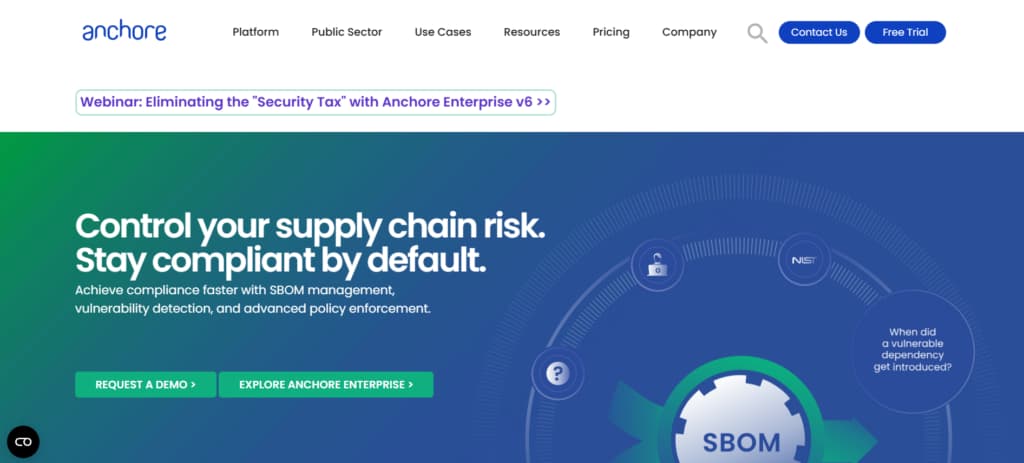
Anchore pioneered the SBOM approach to supply chain security long before regulators required it. It combines vulnerability scanning, secret detection, and malware analysis into a single workflow, giving teams full visibility into their container images and dependencies.
While Snyk focuses on passive scanning, Anchore adds serious compliance automation for NIST, FedRAMP, and DISA. This makes it especially valuable for regulated environments and government work.
The real strength is its built-in policy enforcement. Define rules once, and it blocks bad images right at build time. This shrinks the usual gap between security alerts and actual remediation.
| Attribute | Value |
| Founded | 2016 (SBOM pioneer) |
| Best for | Regulated environments, federal compliance |
| Core strength | Policy-driven container + SBOM analysis |
| Notable feature | Malware detection in dependencies |
Key features
Anchore’s SBOM generation is automatic and exportable in CycloneDX and SPDX formats, satisfying executive orders and supply chain transparency mandates without manual overhead.
The platform scans for known vulnerabilities, secrets accidentally committed to images, and malware signatures in open source packages—three attack vectors that often require separate tools.
Policy gates let teams block deployments based on CVE severity, license risk, or the presence of specific packages, turning security findings into enforceable guardrails rather than advisory noise.
Prisma
Prisma Cloud serves as Palo Alto Networks’ CNAPP for securing cloud infrastructure, workloads, containers, and applications on AWS, Azure, and Google Cloud.
The platform unifies CSPM, workload protection, runtime security, vulnerability management, compliance, and container security in a single place. This helps teams manage risks and keep policies consistent in demanding environments.
Unlike tools that stick to code and dependencies, Prisma Cloud provides wider visibility across cloud resources, Kubernetes, and live runtime activity. That governance-first approach is a big reason it appeals to large multi-cloud teams.
| Attribute | Value |
| Best for | Multi-cloud security teams |
| Core capability | CSPM, CWPP, runtime security, and compliance monitoring |
| Observability | Centralized cloud and workload visibility |
| AI readiness | Supports AI and cloud-native workloads |
Key features
Prisma Cloud is a comprehensive platform that includes CSPM, CWPP, vulnerability management, runtime threat detection, compliance monitoring, and container security.
It provides visibility across AWS, Azure, and Google Cloud, enabling teams to detect misconfigurations, monitor workloads, protect Kubernetes clusters, and enforce rules across the whole lifecycle. Compliance reporting, automated tools, and centralized dashboards enable you to manage everything in one spot.
Oligo Security

Oligo Security’s founding details aren’t publicly documented, but the platform’s architecture signals a post-Snyk generation of tooling.
Where traditional scanners flag every dependency vulnerability regardless of whether your code actually calls the risky function, Oligo watches what executes at runtime. It detects active threats. This eliminates 90–99% of alerts that never posed real risk—developers stop wasting sprint cycles triaging theoretical CVEs and focus on exploitable paths attackers can reach.
Runtime SCA, SBOM generation, and licensing compliance run in parallel. The platform tracks threats across cloud infrastructure, application code, and AI workloads in a single investigation workflow.
Pricing isn’t published on the site, signaling enterprise-tier positioning. For teams drowning in Snyk’s alert volume, Oligo’s execution-based filtering is transformative—security findings finally match actual business risk instead of theoretical possibility.
| Attribute | Value |
| Best for | Teams overwhelmed by false-positive vulnerability noise |
| Core capability | Runtime threat detection across cloud, code, and AI |
| Notable feature | Execution-based analysis eliminates 90–99% of scanner alerts |
| Compliance | SBOM generation and licensing tracking included |
Key features
Oligo’s runtime engine monitors which dependencies your application actually invokes during execution, then cross-references that against vulnerability databases. If a CVE exists in a library you never call, it doesn’t trigger an alert. This reachability-based approach collapses ticket queues overnight.
Real-time investigation tools let security teams trace attack paths from cloud misconfigurations through code execution to data exfiltration attempts—unified visibility that standalone SAST or SCA tools can’t deliver. AI workload monitoring extends coverage into model serving and inference pipelines, catching threats in LLM-powered features.
Methodology
We evaluated and ranked eight leading DevSecOps security platforms. Our criteria included unified scanning capabilities, how well they integrate into workflows, runtime protection features, and clear pricing.
We based everything on verified data: official features, founding details, and public pricing models. Marketing hype was left out, and we skipped platforms that are mostly reviewers instead of real security tools.
The goal was to find solutions with similar depth to Snyk’s multi-layered coverage.
Frequently Asked Questions
Q: How much do these DevSecOps platforms cost in 2026?
A: Pricing depends heavily on the features you pick. Entry-level scanning starts around $50–150 per developer monthly. Full platforms with runtime security and advanced automation usually fall between $200–500. Free options exist for small or open-source teams, but production environments typically need a tailored quote.
Q: Can you explain SAST, SCA, and DAST?
A: Sure—SAST scans your source code statically, SCA checks dependencies for known issues, and DAST probes your live app for weaknesses. Strong tools combine them so you get complete coverage.
Q: Will they work with our CI/CD pipelines like GitHub Actions or GitLab?
A: Yes, integration is generally smooth. They support GitHub, GitLab, and most other CI systems, often blocking bad code before it merges. You can usually get up and running in under half an hour.
Q: When do teams typically see ROI?
A: Expect noticeable improvements in the first three months. Many reduce their vulnerability backlog by 40-60% once things settle. The upfront effort pays off through smarter prioritization and much less noise.
Conclusion
It really comes down to your team’s main pain point. If false positives are overwhelming you, tools like Aikido or Oligo help by adding runtime context and cleaner workflows.
Regulated industries often lean toward Anchore for its strong compliance focus and policy-driven scans. Open-source fans tend to like Opengrep’s transparent, full-powered SAST engine. For large multi-cloud setups, Prisma Cloud is usually the better fit.
No single tool is ideal for all users. However, you may discover an acceptable alternative that helps you meet your Q3 vulnerability objectives without burdening the team if you focus on your largest problem, whether it’s alert noise, compliance requirements, cost, or cloud complexity.