
Blog
Leading Open Banking API Providers for UK Scaling Platforms

If you run a growing SaaS business, you likely need fast access to real-time bank data and reliable payment initiation — without getting tied up in lengthy bank-by-bank integrations and compliance work.
That’s exactly where Open Banking APIs come in. They let you pull financial data, verify accounts, and offer Pay by Bank payments through a properly regulated infrastructure that follows PSD2 standards.
When choosing a provider for UK-focused platforms, most teams look closely at infrastructure depth, bank coverage, API stability, payment performance, and how easily the solution combines AIS (data access) and PIS (payments) in a single integration.
The options below vary in areas like international coverage, payment strength, transaction enrichment quality, recurring billing support, and how flexible they are to implement.
Here’s a comparison of how they position themselves in the Open Banking market:
| Firm | Best for | Founded | Notable specialty |
| Finexer | Scaling SaaS platforms | 2019 | Unified AIS+PIS API for platforms |
| TrueLayer | High-volume UK Pay by Bank | 2016 | Handles ~50% of UK Pay by Bank |
| Plaid | Multi-market data network | 2013 | 12,000+ bank connections |
| GoCardless | Recurring Direct Debit | 2011 | Automated subscription billing |
| Trustly | Cross-border instant payments | 2008 | Azura conversion engine |
| Salt Edge | White-label open banking | 2013 | 5,000+ banks, no license needed |
| Volt | Real-time payment rails | 2017 | Unified A2A network |
| Yapily | VRP + bulk payments | 2017 | Variable Recurring Payments |
| Brite Payments | Instant 24/7 EU payments | 2019 | Proprietary IPN network |
What Open Banking API Providers Actually Do
At their core, Open Banking providers sit between your product and the banks. They translate messy, regulated bank connections into simple, developer-friendly APIs.
Companies rely on them to link customer accounts, fetch real-time transaction history, verify balances and account information, and support Pay by Bank payment workflows — all without touching sensitive banking credentials themselves.
This space exists because of PSD2, which pushed banks to open their systems. In reality, though, bank APIs are still quite fragmented. Providers hide that complexity so you don’t have to manage hundreds of edge cases.
Teams usually look for three key capabilities: AIS (data access), PIS (payment initiation), and structured data enrichment for verification and operational finance workflows.The hard part is choosing a provider whose strengths line up with your specific timeline, geography, and compliance requirements.
How to Choose an Open Banking API Provider
Here’s what actually matters when comparing Open Banking providers:
- Company age — Older platforms (2011–2013) offer battle-tested infrastructure; newer ones (2017+) are more agile.
- Coverage — UK-heavy providers outperform broad networks for UK-centric use cases.
- Pricing — Published usage-based tiers suit scaling businesses; custom deals fit high-volume operations.
- Unified API — Single solutions (AIS + PIS + verification) reduce complexity; specialists may need multiple vendors.
- Licensing — Direct FCA authorisation vs operating under a provider’s licence affects liability.
- Enrichment — High-quality categorisation saves building your own processing pipelines.
Top Open Banking APIs for UK Scaling Platforms in 2026
For UK scaling platforms, the right open banking provider balances deployment speed, compliance, and bank coverage. Below, we assess each platform on what matters most: UK bank connectivity, real-time data reliability, and whether you can operate under their licence or need your own.
TrueLayer
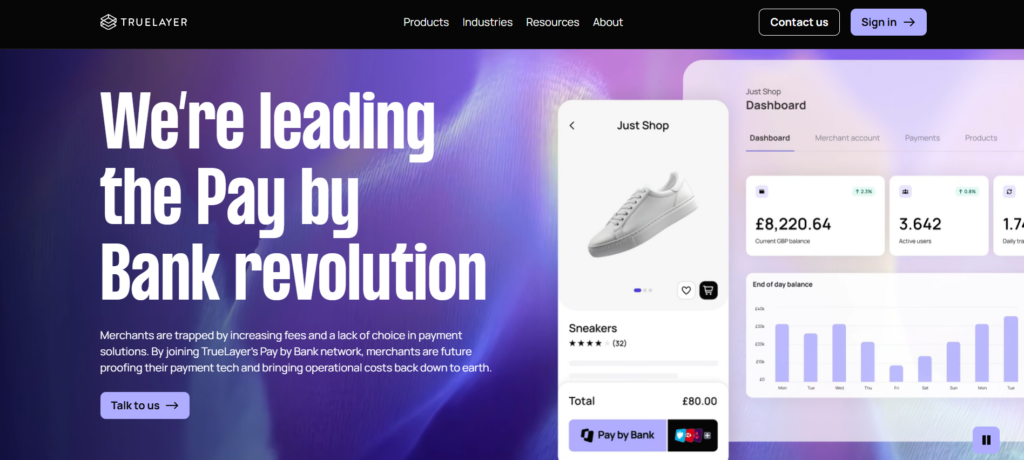
TrueLayer is a leading UK-based provider of Open Banking and Pay by Bank infrastructure. It helps e-commerce, fintech, and financial services companies cut payment friction and reduce costs.
The company, founded in 2016, operates one of Europe’s largest Pay by Bank networks and is fully FCA-authorised. It processes nearly half of all UK Pay by Bank transactions — over 2x its nearest competitors — and has built a strong user base of 20 million+ people, growing by around 1 million users monthly. TrueLayer focuses on delivering high-conversion payment flows for enterprise clients.
Main features:
- Pay by Bank payments;
- Instant payouts;
- Bank on File (stored mandates);
- Data API for transaction and balance information;
- Signup+ for accelerated onboarding.
It also enables recurring payments, verification tools, and real-time data access across European markets. The platform is optimised for large-scale operations in travel, gaming, and subscription businesses.
Finexer
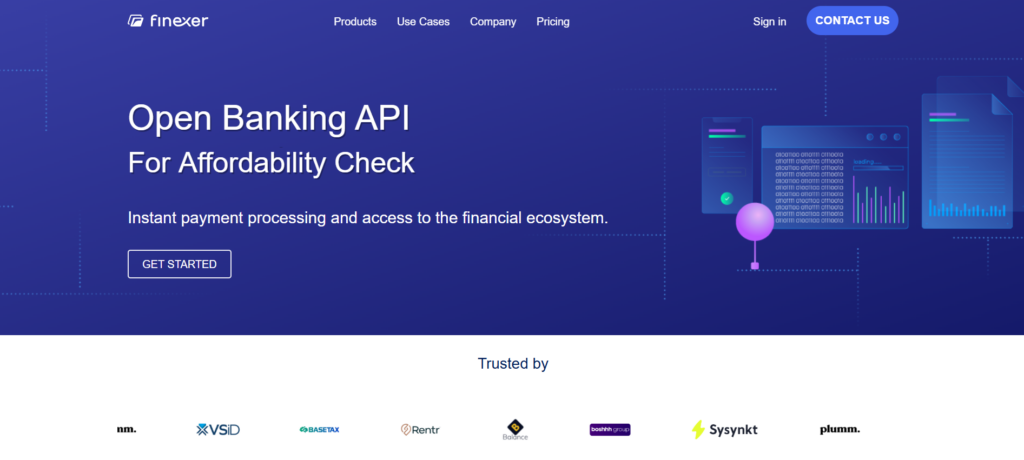
Finexer is an FCA-authorised Open Banking infrastructure provider built specifically for scaling SaaS platforms. It combines real-time bank data access (AIS), Pay by Bank payments (PIS), and verification workflows into one clean API.
Founded in 2019, the company focuses on strong UK coverage with 99% connectivity to UK banks and delivers real-time, audit-ready transaction data. It’s particularly well-suited for platforms that want both financial data and payment capabilities without managing multiple vendors and integrations.
Core capabilities:
- Bank Transactional Data — Real-time access to account transactions.
- Instant Payments — Smooth PIS-based Pay by Bank flows.
- Expense & Income Data — Structured categorisation for operational finance and analysis workflows.
- Data Aggregation — Easy consolidation across multiple accounts.
The platform also offers a white-label solution with custom HTML/CSS styling so you can keep full brand consistency during the consent journey. Pricing is usage-based with startup-tier discounts for pre-revenue businesses and volume tiers for larger companies. Dashboard access, Connect functionality, and white-label options are available across pricing tiers.
Plaid
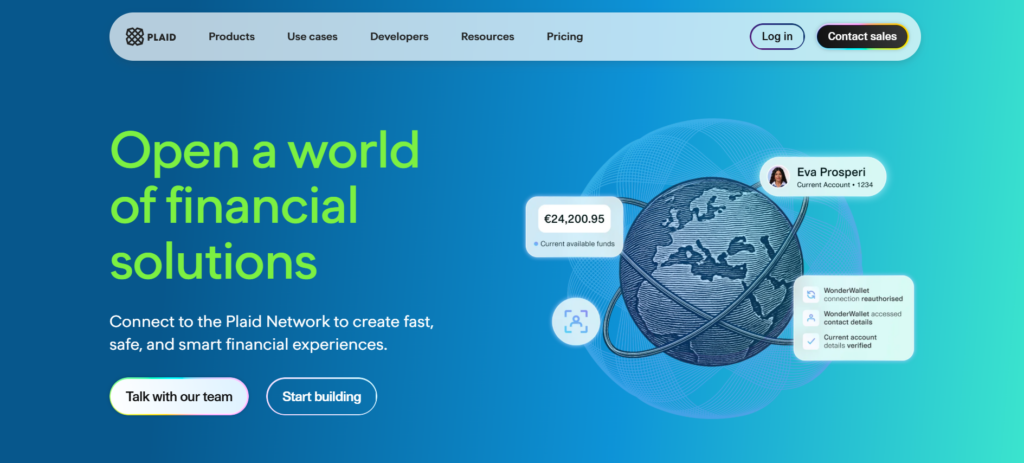
Plaid is a major Open Banking and financial infrastructure platform that makes it easier for businesses to connect with bank accounts, access real-time data, and handle secure account-to-account payments in 20 markets.
Founded in 2013, it runs the world’s largest open banking network — linking to more than 12,000 institutions and serving over 100 million users. Plaid provides APIs focused on account linking, fraud prevention, identity verification, and income checks. The company is fully regulated under PSD2 and supervised by the FCA in the UK and De Nederlandsche Bank in the Netherlands.
Pricing structure:
- Free: Unlimited sandbox access and 200 live calls per product.
- Custom: Unlimited API calls with full support and account management features.
Its real strength lies in multi-market reach. For platforms operating across North America, Europe, and beyond, Plaid reduces vendor fragmentation while supporting key use cases like onboarding, cash flow analysis, and fraud reduction.
GoCardless
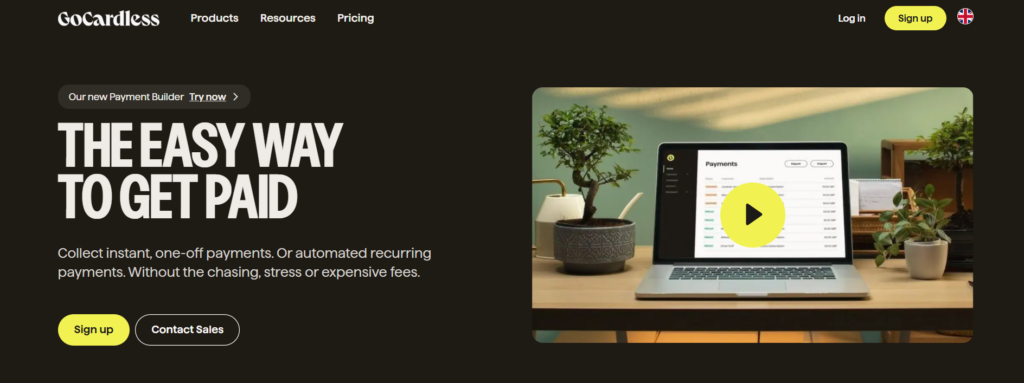
GoCardless specialises in recurring Direct Debit infrastructure—automated payment retries, subscription billing, invoicing, and reconciliation. Founded in 2011, the firm is FCA-authorised and supports payment collection in more than 30 countries.
The platform integrates with over 350 accounting, e-commerce, and business software systems, making it a natural fit for SaaS companies with subscription revenue models.
Strengths:
- Automated payment retries reduce involuntary churn;
- Native integrations with Xero, QuickBooks, Salesforce, Stripe Billing;
- Success+ intelligent payment timing optimises collection rates.
GoCardless doesn’t position itself as a full-spectrum Open Banking provider—it’s narrowly focused on recurring payment collection. If your use case is “subscription billing with bank debits,” GoCardless is purpose-built. If you also need real-time transaction data for underwriting or onboarding, you’ll need a second vendor.
Trustly
Since 2008, Trustly has built a major cross-border payment network linking thousands of merchants to hundreds of millions of consumers worldwide.
It offers instant bank transfers, recurring payments, customer verification, smooth onboarding, and efficient cross-border payouts. The platform works particularly well for e-commerce, travel, gaming, subscription services, utilities, and financial companies.
Key features:
- Instant bank transfers (real-time A2A payments);
- Automated recurring payments for subscriptions and utilities;
- Cross-border payouts with compliance support;
- Azura engine for personalised, higher-converting checkouts.
Trustly handles payments from start to finish and supports both direct API integrations and easy connections through existing PSPs. It’s especially useful for businesses operating in multiple countries where local payment rails vary.
Salt Edge
Salt Edge builds open banking API solutions that empower businesses to create smart services for their customers, with no license requirement for clients.
With over a decade of open banking expertise and connections to 5,000+ banks across 50+ countries, Salt Edge enables businesses to innovate without needing their own license, backed by ISO 27001 certification and the highest security standards. Founded in 2013, Salt Edge is PSD2-licensed and ISO 27001-certified, offering white-label solutions for firms that want to offer Open Banking capabilities under their own brand.
Product capabilities:
- Data aggregation;
- Payment initiation;
- Customer onboarding & KYC;
- Personal finance management;
- Mobile SCA authentication.
You can explore countless possibilities and innovate without acquiring your own open banking licence or certificates. Instead, you can use Salt Edge’s. This licensing-as-a-service model appeals to fintech startups and mid-market platforms that want to move fast without 12-18 month FCA application timelines.
Volt
Volt connects thousands of banks and real-time payment schemes across multiple territories, allowing businesses to process Pay by Bank transactions, payouts, refunds, and virtual account services through a harmonised infrastructure layer.
Founded in 2017, Volt targets e-commerce, crypto, iGaming, retail, and wealthtech businesses that need scalable real-time payment connectivity.
Core products:
- Instant Payments;
- Refunds;
- Payouts;
- Volt Accounts (virtual IBANs);
- Payment verification;
- Fraud protection infrastructure.
Volt’s positioning emphasises cross-border real-time commerce—the firm reduces reliance on card networks and payment intermediaries by routing payments through domestic instant payment rails. Coverage spans hundreds of millions of bank accounts globally, with a focus on unifying fragmented payment schemes under one API.
Yapily
Yapily, founded in 2017, offers a comprehensive Open Banking platform covering instant payments, data aggregation, transaction enrichment, bulk payments, and Variable Recurring Payments (VRP). It connects to more than 2,000 banks across 19 European countries, with solid depth in the UK and Germany.
One of its biggest advantages is Yapily Connect — a licensing service that allows companies to access Open Banking capabilities without applying for their own PSD2 licence. This can save fintechs and payment providers 12 to 18 months of regulatory work.
Main features:
- Instant payments;
- Financial data aggregation & enrichment;
- Bulk payments;
- Variable Recurring Payments (VRP) for dynamic subscriptions and instalments;
- Support for both consumer and business accounts.
The platform works well for lending, iGaming, embedded finance, and other sectors that need fast onboarding, verification, and flexible payment options.
Brite Payments

Brite’s proprietary Instant Payments Network (IPN) connects over 3,800 European banks and runs 24/7/365 with almost no fraud or chargebacks. This removes the usual problems of card networks and bank cut-off times.
Founded in 2019, Brite is a licensed Swedish Payment Institution supervised by Finansinspektionen and operates under PSD2.
Core capabilities:
- Instant Payments — Real-time account-to-account transfers;
- Instant Payouts — Same-day settlements to merchants;
- Account Verification — KYC and ownership checks;
- Income Insights — Transaction-based income analysis.
As a fully regulated entity, Brite follows strict security and compliance standards. The always-on network eliminates delays common in traditional banking, making it especially attractive for high-risk sectors like gaming and crypto, where fraud is a bigger issue.
Frequently Asked Questions
Q: How much does Open Banking API integration cost?
A: Pricing varies quite a bit. You can usually start testing for free in sandbox mode. Once live, costs generally fall between £0.10–£0.50 per data call and £0.20–£1.00 per payment. Many providers offer startup discounts or volume-based pricing for larger users.
Q: Do I need my own PSD2 licence to use these platforms?
A: Not at all. You can build under the provider’s existing licence instead of getting your own. This is the standard model and helps teams move much faster.
Q: How long does it take to integrate?
A: Most teams get basic integrations live in 2–8 weeks. Simpler single-feature setups are on the shorter end, while combining data, payments, and verification pushes it toward the higher side. Good sandbox environments make a real difference.
Q: What’s the difference between AIS and PIS?
A: AIS gives you read access to account information like balances and transaction history. PIS allows you to initiate payments on behalf of the customer. Some providers specialise in one area, others combine both cleanly.
Q: Who offers the strongest UK bank coverage?
A: Finexer reaches 99% of UK banks with excellent real-time data. TrueLayer leads in payment volume, processing nearly 50% of UK Pay by Bank transactions. Plaid is better if you need wide coverage beyond the UK.
Conclusion
Our ranking focused on four main factors: documented infrastructure scale (banks, volume, users), years in operation as a sign of maturity, clear strength in UK Open Banking (both AIS and PIS), and transparency in their public materials.
We excluded providers with weak English documentation, unclear licensing, or those positioned outside proper Open Banking APIs. Everything here is based on publicly available facts — no inflated claims.
At the end of the day, scaling fintechs and SaaS platforms still struggle with the same issue: integrating multiple bank APIs without massive compliance overhead. The providers we covered each solve a different part of this challenge — whether it’s high UK payment volume, broad data coverage, recurring collections, or unified infrastructure.