
Blog
6 Real-Time Enablement Platforms for Healthcare and Financial Services

Healthcare and financial services share a common challenge. Compliance rules change constantly. Systems must protect sensitive data. Users need guidance without compromising security.
Traditional training fails in these environments. Employees forget what they learned. They make errors that have serious consequences. A misplaced decimal in finance. A misfiled record in healthcare. Both create real problems.
Real-time enablement platforms solve this. They guide users inside applications. They provide help exactly when needed. They maintain audit trails for compliance. For organizations in these regulated sectors, finding the right top digital adoption solution for healthcare and financial services can mean the difference between smooth rollouts and compliance violations.
This piece examines six platforms built for regulated industries. Each one helps organizations deploy software while maintaining compliance. Some focus on governance. Others emphasize speed. The selection reflects tools that actually work in healthcare and financial services.
1. Tango
Best for: Healthcare and financial services teams that need rapid process documentation with compliance controls.
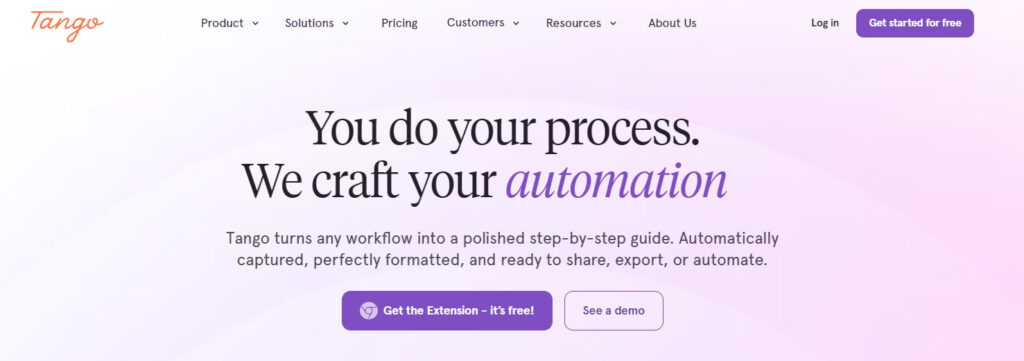
Tango captures workflows automatically through a browser extension. Users click through their process once.
The platform generates step-by-step guides with annotated screenshots. Enterprise plans include automatic PII detection and redaction, SSO and SCIM provisioning, and 365-day version history with audit logs. The secure blur feature automatically detects and redacts sensitive information, which is critical for HIPAA and SOX compliance.
Tango serves as a top digital adoption solution for healthcare and financial services that helps organizations preserve tribal knowledge before employees leave. Pro plans start at $15 per user per month. The free tier supports up to ten users.
Why it works for regulated industries:
- Automatic PII detection and redaction protect sensitive data
- 365-day version history with audit trails for compliance
- SSO and SCIM provisioning for secure access control
- Captures processes automatically without manual documentation
- Guides live inside applications, not in external portals
2. WalkMe
Best for: Large healthcare and financial services organizations that need cross-application guidance with strong governance controls.
WalkMe adds visual cues and personalized content across enterprise software. The platform includes data capabilities to uncover software usage, action features to fix broken workflows, and experience tools to create guidance that allows employees to complete tasks correctly. WalkMe is trusted by the U.S.
Department of Defense and global leaders like IBM, Nestlé, and ThermoFisher Scientific. This makes it suitable for healthcare organizations subject to HIPAA and financial institutions subject to SOX compliance.
For companies that handle integrations, this platform works like a guidance tool for employees. It helps with combining systems after a merger and keeps everything under control. The yearly licensing fee is between $24,000 and $32,000.
* Additional professional services cost extra.
Why it works for regulated industries:
- Trusted by the U.S. Department of Defense for secure environments
- Serves healthcare and financial services with governance controls
- Hesitation heatmaps reveal compliance risks in workflows
- Cross-application guidance maintains consistency across systems
- Automation reduces repetitive tasks in regulated processes
3. Whatfix
Best for: Financial services and healthcare organizations that need simulation training before go-live with strong governance controls.
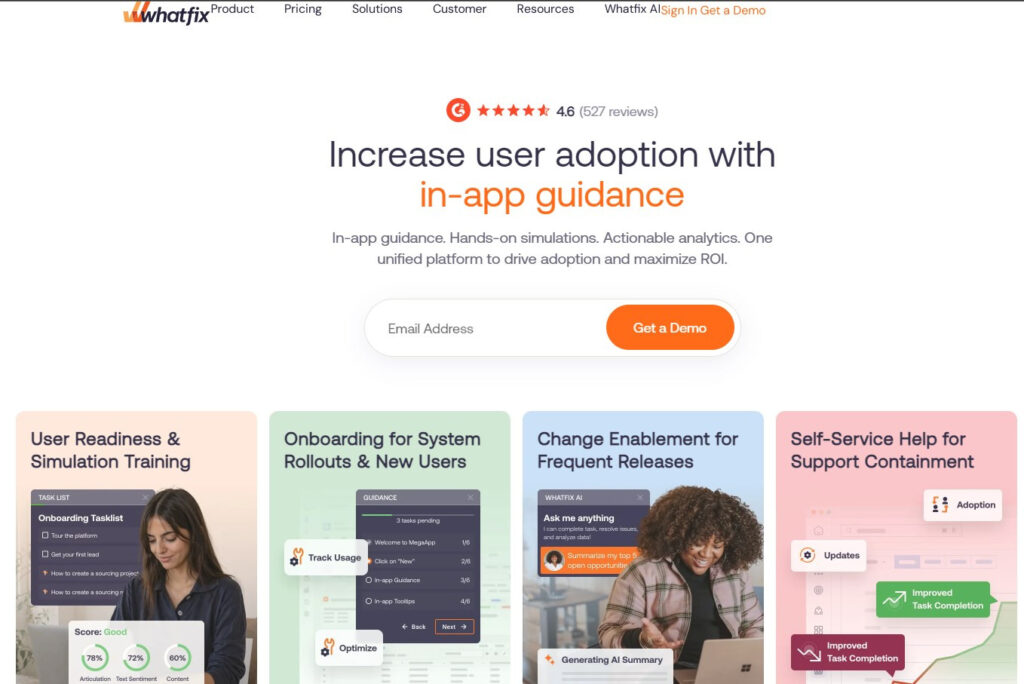
Whatfix Mirror makes copies of application environments for training on workflows and AI roleplay.
Users practice workflows in a safe test area, making fewer costly errors and getting better faster.
The platform helps replicate environments for systems, such as:
- Salesforce
- SAP
- Oracle
- Workday
- ServiceNow
Mirror can be saved as a SCORM package to work with Learning Management Systems. It also has dashboards that show how many users complete training.
Whatfix operates as a top digital adoption platform for enterprise software rollouts with industry solutions for Banking, Financial Services, Insurance, and Healthcare. Implementation typically requires professional services and engineering teams.
Why it works for regulated industries:
- Mirror simulation training for pre-go-live readiness in a risk-free environment
- Industry solutions for Banking, Financial Services, Insurance, and Healthcare
- Replicates Salesforce, SAP, Oracle, Workday, and ServiceNow
- SCORM export for LMS integration and compliance training
- Analytics dashboards track completion rates for audit purposes
4. Pendo
Best for: Healthcare and financial services organizations that need to understand how users behave and improve usage.
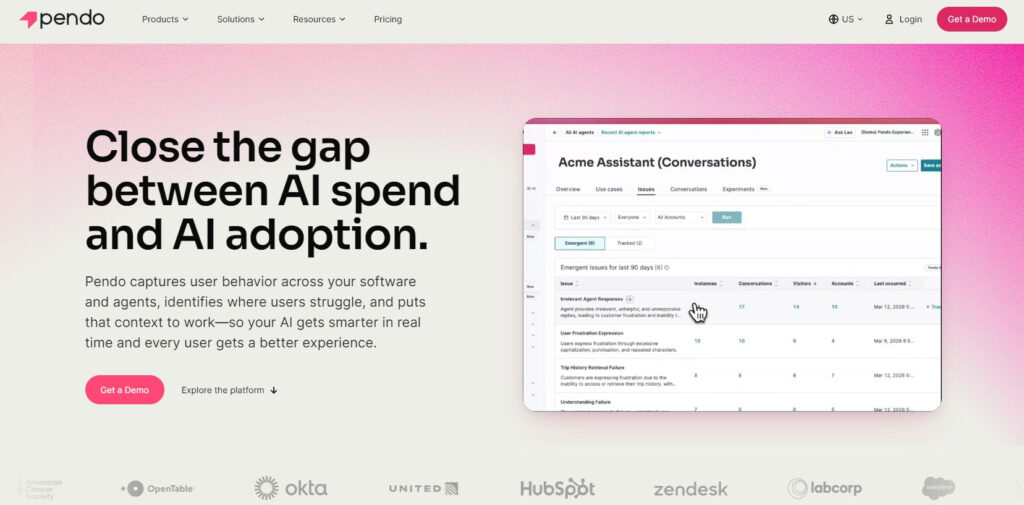
Pendo is a tool that helps organizations understand how users interact with their products. It does this by combining data on user behavior with guidance on how to use the product. This helps teams see where users get stuck in complex and regulated industries.
Pendo is mainly used by product teams to understand how users navigate their products, find problems, and then create guidance to improve specific behaviors. The platform works well for organizations that have different applications, making it suitable for healthcare or financial organizations that use multiple systems.
The guidance features support the data rather than being the main focus. Pendo is a software that helps enterprises understand how users behave across regulated systems.
However, Pendo can be complex to use for large enterprises, and it takes time to get the most out of it. The price starts at around $7,000 per year. There is a free version for up to 500 active users per month.
Why it works for regulated industries:
- Deep usage analytics reveal compliance training gaps
- Session replay shows where users struggle with regulated workflows
- Behavior-triggered guidance prevents errors in sensitive processes
- Scales across multiple applications in healthcare and finance
- Free tier for smaller organizations
5. Spekit
Best for: Financial services and healthcare organizations heavily invested in Salesforce that need in-context training for revenue teams.
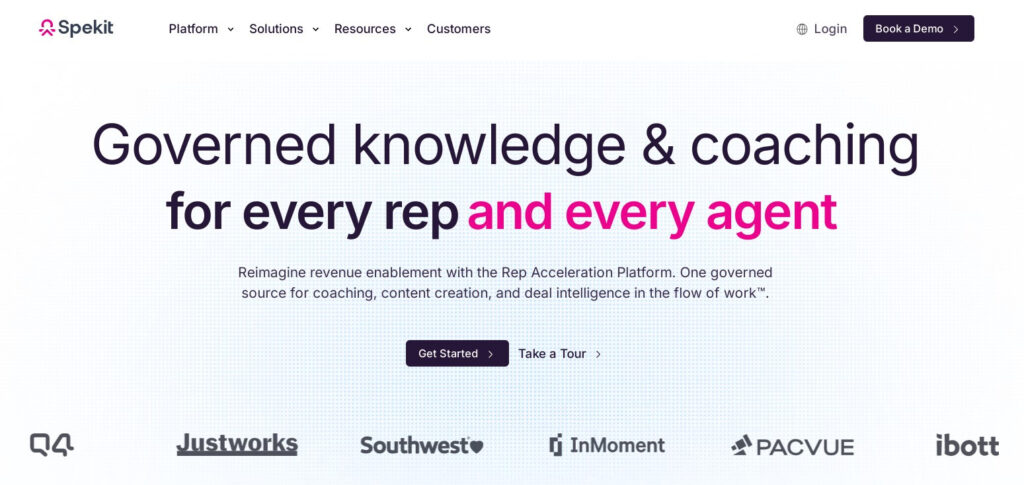
Spekit provides contextual Salesforce guidance directly inside the application, preventing confusion caused by outdated how-tos. The platform helps reduce ramp time for new employees and new processes. Users avoid hunting through outdated documentation because guidance appears where they work.
Spekit serves as a premier knowledge transfer tool for enterprise software deployments for CRM-focused organizations. The platform integrates with Salesforce, Azure, HubSpot, OneLogin, and Okta. Pre-built Salesforce integrations allow fast deployment.
The narrow focus is both a strength and a limitation. Spekit works well for Salesforce-heavy organizations but is not suited for enterprise-wide software adoption across varied tool sets.
Why it works for regulated industries:
- Contextual Salesforce guidance inside the application reduces errors
- Reduces ramp time for new representatives in regulated environments
- Prevents confusion caused by outdated how-tos
- Integrates with Salesforce, Azure, HubSpot, and Okta
- Built specifically for revenue team workflows
6. Stonly
Best for: Healthcare and financial services organizations that need interactive guides with branching logic for complex regulated workflows.
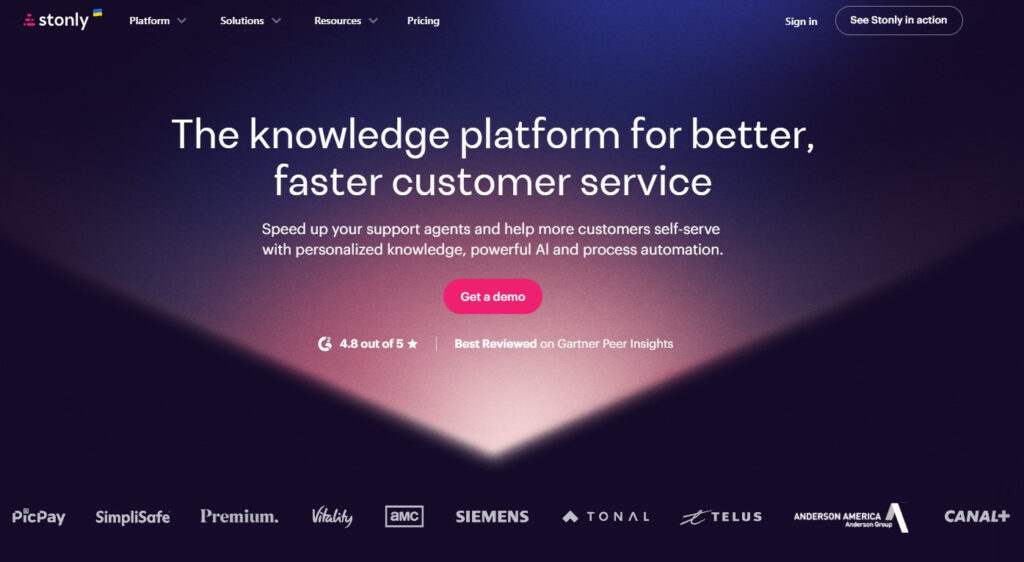
Stonly provides interactive guides with branching logic that creates complex interactive decision trees. The platform includes a no-code drag-and-drop editor that allows non-technical users to create guides without writing code. Guides can be embedded via one snippet of code anywhere – on websites, in help centers, or inside applications.
Stonly operates as a high-quality in-app guidance platform for Salesforce and Oracle environments. Analytics show where users get stuck and drop off, revealing compliance training gaps. The free tier supports unlimited public guides. Pro plans start at $165 per month.
Why it works for regulated industries:
- Branching logic handles complex, non-linear regulated workflows
- No-code drag-and-drop editor for compliance teams
- One snippet of code for quick deployment
- Analytics reveal where users get stuck in regulated processes
- Free tier for unlimited public guides
Side-by-Side Platform Comparison
The differences between these platforms become clear when viewed side by side. Here is how each one serves regulated industries.
| Platform | Primary Strengths | Implementation Speed | Key Differentiator |
| Tango | Automatic capture with PII redaction | 24 hours | PII detection; audit logs; SSO/SCIM |
| WalkMe | Cross-application governance | Weeks to months | Trusted by DoD; hesitation heatmaps |
| Whatfix | Simulation training; industry solutions | Weeks to months | Banking, Financial Services, Healthcare solutions |
| Pendo | Analytics-first; session replay | Weeks | Deep usage analytics; behavior-triggered guidance |
| Spekit | In-context Salesforce training | Days | CRM-focused; pre-built Salesforce integrations |
| Stonly | Interactive guides; branching logic | Days | No-code; automatic updates |
The table shows how each platform approaches regulated environments. Some prioritize speed. Others focus on governance. The right fit depends on what the organization needs most.
FAQ
Healthcare and financial services organizations evaluating real-time enablement platforms typically ask the same questions. Here is what you need to know.
Why are healthcare and financial services industries different for software rollouts?
These industries handle sensitive data. Compliance requirements like HIPAA and SOX mandate strict controls. Employees must follow precise workflows. Errors have serious consequences. Real-time enablement platforms guide while maintaining security and audit trails. For organizations managing these challenges, finding the right top digital adoption solution for healthcare and financial services becomes essential.
When it comes to healthcare rollouts, which platform’s the best choice?
Tango is a good option because it can automatically find and remove personal information, and it also has single sign-on and user provisioning. It keeps a record of all changes for 365 days. You can see what happened with the audit logs.
Whatfix is also used by healthcare organizations because they have good governance controls and compliance features to keep everything in order.
Which platform is best for financial services rollouts?
Whatfix offers industry solutions for Banking, Financial Services, and Insurance. WalkMe serves heavily regulated environments with governance controls. Tango provides audit trails and secure blur for sensitive data.
Do these platforms help with compliance training?
Yes. Real-time enablement platforms embed guidance inside applications. Employees learn correct workflows while working, not in separate training sessions. This reduces errors and maintains compliance. Analytics reveal where users struggle, identifying training gaps.
How long does implementation take in regulated industries?
Implementation depends on the platform and the organization’s security requirements. Tango goes live within 24 hours. WalkMe and Whatfix typically require weeks or months of professional services. Spekit deploys within days for Salesforce-focused use cases. Pendo and Stonly take days to weeks.
Can these platforms integrate with existing security protocols?
Yes. Tango includes SSO, SCIM, and automatic PII detection. WalkMe and Whatfix offer enterprise-grade security. Spekit and Stonly provide secure access controls. Most platforms support SOC 2 compliance and data protection standards.
Bottom Line
Regulated industries face unique challenges during software rollouts. Healthcare and financial services organizations must maintain compliance while helping employees adopt new systems. Real-time enablement platforms address both needs.
Tango offers automatic capture with PII detection and audit trails. WalkMe provides cross-application governance trusted by the U.S. Department of Defense. Whatfix delivers industry-specific solutions with simulation training. Pendo combines analytics with guidance. Spekit focuses on Salesforce workflows. Stonly offers interactive guides with branching logic. These top digital adoption solutions for healthcare and financial services help organizations maintain compliance while driving user adoption.
Each platform is used by industries that have to follow rules. The best platform for you depends on the systems you have and what you need to do to follow the rules. How soon do you need to get everything done?
If you need to get started and still follow the rules, you should think about Tango because it is a good mix of being fast, secure, and able to do what you need. Tango has a balance of speed, security, and capability, which is what teams need when they have to get started quickly with compliance controls.