
Blog
4 Product Engineering Services for Cloud and Embedded Systems

Two different engineering worlds now overlap. Cloud computing lives in data centers. Embedded systems live inside devices. Modern products need both to work together.
A car sends tire pressure data to the cloud. A factory machine uploads temperature readings every second. A medical device syncs patient vitals to a hospital network. Each use case requires teams that understand hardware constraints and cloud scalability.
Here are four firms providing product engineering services across both domains.
What Cloud and Embedded Integration Requires
Building connected products is harder than building pure software. Memory limits matter. Battery life matters. Network connections drop. The cloud side must handle millions of devices sending data at once.
Successful companies in this field have certain skills in common:
- They fit working software onto chips with less memory than a cheap digital watch.
- They transmit messages using MQTT, CoAP, LoRa, BLE, and Zigbee.
- They refresh the software inside products sitting on store shelves or in garages.
- They filter and process sensor readings near the source before any data travels to the cloud.
The four firms listed below have built products that connect hardware devices to cloud platforms.
Why This Combination Matters Now
Factories install sensors that report machine wear. Farms use soil monitors that send moisture readings. Hospitals track infusion pumps through ward networks. Each scenario needs code running on tiny chips plus servers processing that data.
A team good at only one side creates problems. Pure cloud engineers write code that a thermostat cannot run. Pure embedded engineers build devices that cannot talk to anything. The four firms above employ people who understand both constraints.
1. Avenga
Best for: Automotive and mobility embedded systems
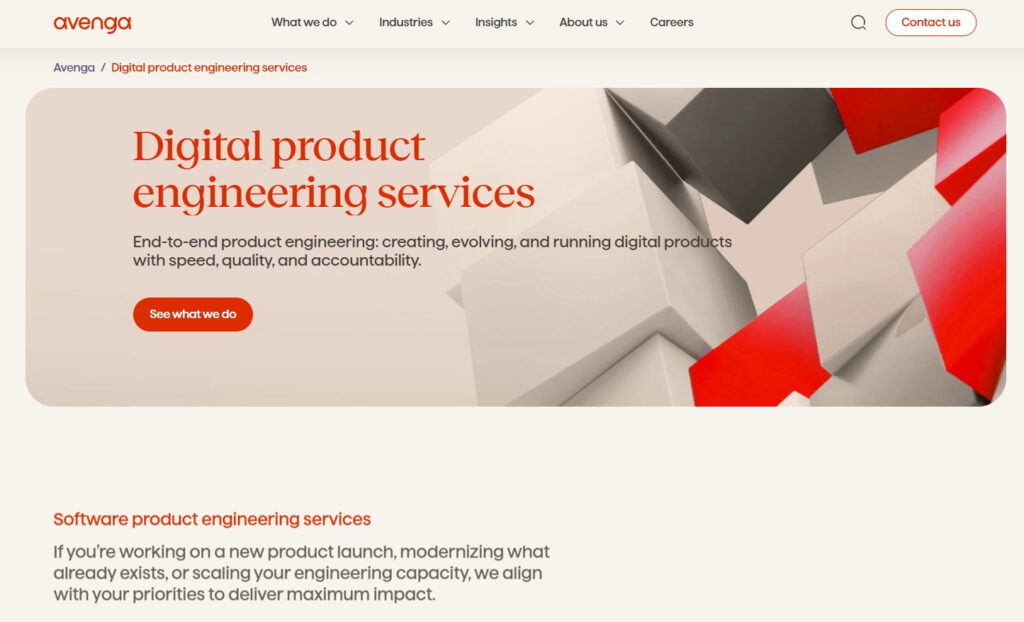
Avenga sits at the table with automakers as a product engineering company and technical collaborator. The firm keeps over 300 engineers focused solely on vehicles. Those engineers build the software for digital dashboards, in-car entertainment, and the systems that manage acceleration and braking.
For the cloud portion, Avenga creates IoT platforms that pull data from vehicle sensors and GPS trackers. Those platforms send information to analytics systems on AWS, Azure, or Google Cloud. The company helps car makers move from one-time vehicle sales to subscription-based mobility services where customers pay per trip.
One notable solution involves post-production vehicle analytics. Avenga creates systems that track vehicle performance after leaving the factory. Fleet operators receive predictive maintenance alerts. Manufacturers get usage patterns for future designs. The architecture scales from pilot programs with a few hundred vehicles to full deployments across entire fleets.
2. EPAM
Best for: Vehicle-to-cloud platforms and connected devices
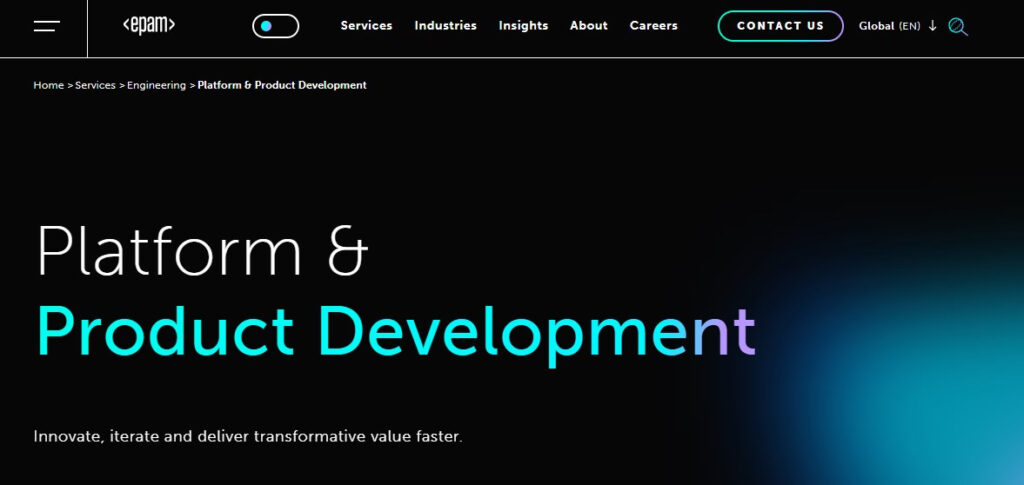
EPAM teamed up with Renesas Electronics to launch AosEdge, a platform that connects cars to the cloud. The system sends software updates to vehicles wirelessly, the same way phones get new operating system versions. AosEdge splits into two parts: AosCloud handles the cloud side, while AosCore runs on Renesas R-Car computer chips inside each vehicle.
The platform supports microservices architecture for automotive applications. Developers with limited automotive knowledge can write in-vehicle software because the system configures independently of vehicle architecture. The platform complies with open standards, including Vehicle Information Service Specification (VISS).
AosEdge works with any cloud environment, whether an automaker’s private cloud or public providers. EPAM also provides 24/7 support for managing features like emergency assistance. The platform extends beyond vehicles to other IoT applications requiring a similar cloud-to-edge architecture.
3. Nagarro
Best for: Full-stack embedded electronics design
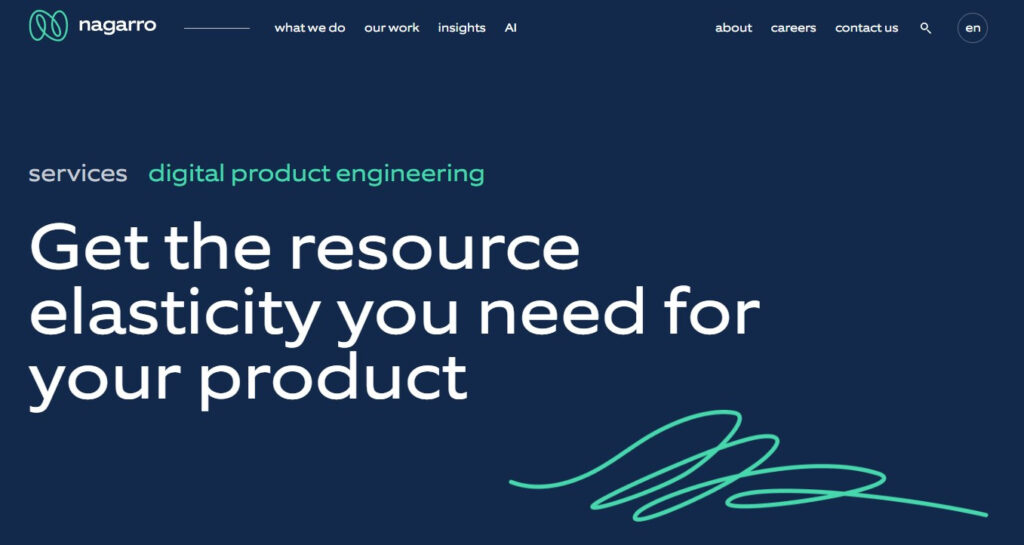
Nagarro provides product engineering services for all aspects of electronic system design, from hardware to firmware. Their embedded services cover hardware design, firmware development, operating systems, device drivers, and networking protocols. The firm handles niche areas including robotics and automation.
Nagarro also takes on the low-level electronics tasks. Their teams sketch circuit layouts, power up prototype boards for the first time, write the code that loads when a device turns on, and create software that talks to hardware components. Their firmware operates directly on processors without an operating system, inside real-time environments such as FreeRTOS, and on embedded Linux systems, including Yocto.
The company speaks many device languages. TCP/IP, MQTT, and CoAP for networking. Wi-Fi, BLE, LoRa, Zigbee, NFC, and Thread for wireless. CAN, LIN, and SOME/IP for cars. Nagarro also advises clients on product roadmaps, whether to build or buy components, and how to protect new inventions.
4. Ciklum
Best for: Embedded firmware modernization and IoT platforms
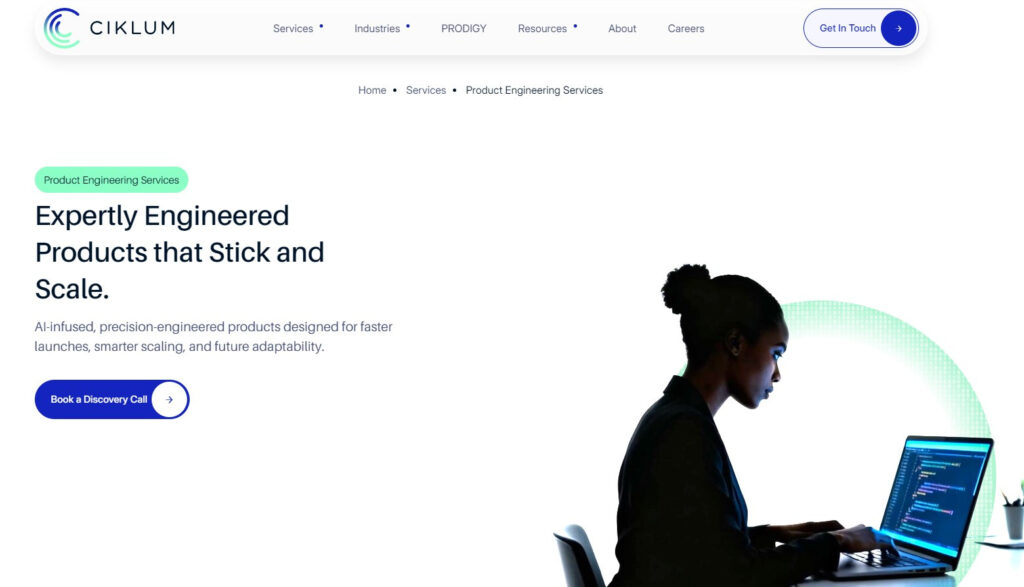
Ciklum employs more than 4,000 people worldwide. A dedicated embedded group operates from India. The company refreshes aging firmware and retrofits older products with internet connectivity.
Ciklum’s embedded staff writes code for Cortex M0, M3, M4, and M7 processors. They program Nordic semiconductors using the nRF5 development kit. Their devices communicate through Ethernet, Wi-Fi, Bluetooth, and Zigbee. Real-time operating systems include FreeRTOS and several others. The team builds low-power electronics for battery-operated products.
The firm constructs early-stage prototypes and researches new embedded use cases before client commitment. Their IoT portfolio includes collecting telemetry from devices, automating product lifecycles, and securing connected gadgets against intrusion. Ciklum serves both Fortune 500 corporations and early-stage startups.
Comparison Table: Cloud and Embedded Capabilities
These four firms come at cloud and embedded work from different angles. The table below lines up their specialties side by side.
| Firm | Embedded Focus | Cloud Focus | Key Protocols | Industries |
| Avenga | In-vehicle, SDV, IVI | IoT analytics, AWS/Azure/GCP | Telematics, V2X | Automotive, Mobility |
| EPAM | AosCore on Renesas SoC | AosCloud, any cloud environment | VISS, OTA | Automotive, Connected Devices |
| Nagarro | Full electronics design, firmware, RTOS | IoT platforms | MQTT, CoAP, BLE, LoRa, Zigbee | Robotics, Consumer Electronics |
| Ciklum | Firmware modernization, Cortex M | IoT platforms | Ethernet, Bluetooth, Zigbee | Telecom, Consumer Electronics |
Those rows show technical differences. But product managers usually care about different things. The FAQ section below answers the practical questions that come up in planning meetings.
Frequently Asked Questions
Here is a straight comparison of these four companies.
Q: What separates a pure embedded system from a cloud-connected device?
A: An embedded system runs code directly on a processor with strict resource limits. Consider a home thermostat chip containing 32KB of total memory. A cloud-connected device includes wireless hardware to transmit readings to remote servers. The real difficulty emerges when a device has severe constraints, but the cloud side expects limitless data.
Q: Which cloud services receive data from embedded devices?
A: The main options are AWS IoT Core, Azure IoT Hub, and Google Cloud IoT. Avenga works with all three. EPAM’s AosEdge runs on any cloud environment, including private data centers owned by car companies. The selection usually follows existing corporate agreements rather than technical requirements.
Q: What price range should someone expect for embedded and cloud engineering?
A: None of these four companies posts standard rates publicly. EPAM may charge licensing fees for AosEdge beyond engineering services. Nagarro’s hardware design costs exceed pure software work because of physical prototypes and components. Expect personalized quotes after discussing device quantities and production scale.
Q: Can any of these firms handle regulatory approval for medical or automotive products?
A: Each company has a different compliance experience. Avenga handles automotive safety standards through their software-defined vehicle division. EPAM designed AosEdge with Renesas to meet automotive reliability requirements. Ciklum mentions regulatory protections for telecommunications clients but does not emphasize medical certifications. Ask each firm directly about ISO 26262 for automotive projects or IEC 62304 for medical devices.
Q: Which company works best for a startup creating its first internet-connected product?
A: Ciklum openly states that they support scaling startups and building proof-of-concept prototypes. Nagarro provides fast prototyping and minimum viable product development for embedded systems. Both companies have transitioned products from small test batches to full manufacturing volumes.
Final Thoughts
Ten years ago, cloud software engineers and embedded hardware engineers worked in separate departments. They attended different meetings and used different tools. A car company would hire one firm for the infotainment screen and another for the backend servers. Those days are over.
Every new product now ships with chips and cloud connections. The four companies above employ people who understand both sides. Pick the one that matches your specific hardware and your scale.
Avenga brings automotive-grade embedded work with cloud analytics for fleet data. EPAM offers a complete vehicle-to-cloud platform with Renesas silicon backing. Nagarro handles full electronic design from schematics to firmware. Ciklum modernizes existing embedded systems for connected features.
Pick based on where your product sits. Pure hardware startup with no cloud experience? Ciklum or Nagarro. Automaker connecting millions of vehicles? Avenga or EPAM. The firms above cover the full spectrum.