
Blog
Software Delivery Bottlenecks Are Changing. These 7 AI Development Firms Are Adapting Faster

Enterprise engineering teams are discovering something uncomfortable about modern software delivery.
The biggest bottlenecks are no longer always technical. For years, organizations focused heavily on optimizing infrastructure, deployment pipelines, testing coverage, cloud scalability, and development velocity. Most enterprises already invested heavily in DevOps, automation frameworks, CI/CD systems, and cloud-native engineering practices. But despite all that optimization, delivery friction never fully disappeared. It simply moved.
Today, engineering slowdowns increasingly come from workflow fragmentation, operational coordination gaps, inconsistent architecture governance, overloaded QA environments, disconnected planning systems, infrastructure complexity, and delivery visibility problems spread across distributed teams.
In other words, software delivery became operationally heavier than many organizations expected.
This is exactly why AI adoption inside enterprise engineering is evolving so quickly.
The strongest engineering organizations are no longer using AI only to accelerate coding tasks. They are embedding AI into the operational systems surrounding software delivery itself — planning, architecture, testing, DevOps, governance, incident coordination, and engineering visibility.
That creates a much broader transformation than the original copilot wave. The firms attracting attention now are usually the ones helping enterprises redesign software delivery operations around AI-assisted workflow coordination rather than isolated automation.
Here are seven AI development firms enterprises increasingly evaluate as delivery bottlenecks continue shifting across the SDLC.
1. Avenga
Avenga AI driven software development services approaches enterprise AI adoption through workflow orchestration across the SDLC rather than isolated engineering acceleration.
That distinction matters because many delivery bottlenecks now appear between engineering functions rather than inside development itself.
Projects slow down during planning. Requirements become inconsistent across delivery teams. Architecture governance loses traceability over time. QA operations struggle under faster release cycles. Incident response workflows depend heavily on fragmented operational history spread across systems.
Avenga’s AI-driven software development company model focuses heavily on embedding AI into those operational coordination layers.
The company supports AI integration across:
- Estimation and planning
- Requirements engineering
- UX and design workflows
- Architecture analysis
- Engineering operations
- QA automation
- DevSecOps coordination
- Incident response environments
One especially strong differentiator is how interconnected the operational model becomes.
Many enterprises already have developers experimenting with AI independently. The larger challenge is workflow consistency across engineering ecosystems. Disconnected AI adoption often creates fragmented delivery operations and inconsistent governance visibility between teams.
Avenga’s Intelligent Flow framework addresses that by standardizing AI integration across the SDLC itself rather than allowing isolated departmental experimentation.
Another important strength is role-specific workflow alignment. Instead of generic AI assistants disconnected from operational engineering environments, product managers, architects, QA specialists, developers, and infrastructure teams all work with AI systems aligned to their own delivery context.
That creates significantly more continuity throughout engineering operations.
The company also combines AI-native delivery transformation with broader modernization expertise involving enterprise product engineering, cloud infrastructure transformation, operational scalability, and governance-heavy delivery ecosystems.
2. Intellias
Intellias has expanded its AI engineering capabilities significantly across enterprise product engineering and operational modernization environments.
The company supports organizations embedding AI systems into distributed software delivery ecosystems involving cloud-native infrastructure and enterprise-scale engineering operations.
Capabilities include:
- AI-assisted engineering
- Product delivery optimization
- Workflow automation
- Enterprise platform engineering
- Cloud-native systems
- Data infrastructure
Intellias is especially relevant for organizations combining AI adoption with broader engineering transformation initiatives.
A strong advantage is operational systems integration.
Modern software delivery environments increasingly require architecture governance, DevOps coordination, QA systems, infrastructure platforms, and engineering workflows to function with greater continuity across the SDLC. Intellias supports those integration-heavy ecosystems effectively.
The company also works across modernization initiatives involving cloud transformation and platform engineering.
3. N-iX
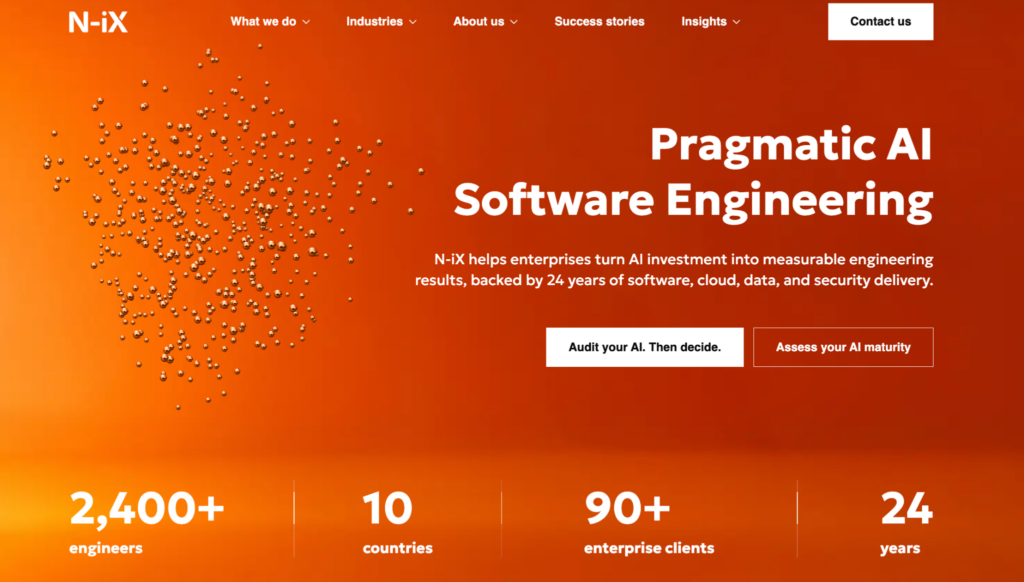
N-iX has expanded its AI engineering capabilities significantly across enterprise modernization and AI-enhanced delivery environments.
The company works with organizations integrating AI systems into distributed engineering ecosystems and cloud-native delivery operations.
Capabilities include:
- AI engineering
- Workflow automation
- SDLC modernization
- Enterprise product development
- Cloud-native delivery systems
- Data engineering
N-iX is especially relevant for enterprises operationalizing AI throughout larger engineering workflows rather than isolated development tooling.
One reason organizations evaluate the company is the depth of infrastructure coordination.
Modern delivery bottlenecks often emerge from synchronization problems between testing systems, cloud platforms, DevOps operations, CI/CD environments, and governance workflows. N-iX supports those implementation ecosystems effectively.
The company also works heavily across modernization initiatives involving scalable engineering operations and distributed product delivery systems.
4. ELEKS
ELEKS focuses heavily on enterprise technology consulting and AI-enhanced engineering transformation projects.
The company supports organizations embedding AI capabilities across software delivery systems and enterprise engineering workflows.
Capabilities include:
- AI-driven development
- Workflow automation
- Enterprise engineering modernization
- QA transformation
- Cloud engineering
- Platform engineering
ELEKS is frequently evaluated by enterprises looking for consulting depth combined with implementation capability across operationally demanding engineering ecosystems.
Its broader engineering background becomes especially valuable once AI adoption expands beyond experimentation into production-scale SDLC environments involving governance coordination and infrastructure complexity.
The company also supports modernization programs involving enterprise architecture and cloud-native infrastructure.
5. SoftServe
SoftServe has invested heavily in AI-enhanced engineering environments and enterprise delivery modernization initiatives.
The company supports organizations embedding AI into software engineering operations involving distributed product teams, analytics ecosystems, enterprise platforms, and cloud-native infrastructure.
Capabilities include:
- AI-driven engineering modernization
- Enterprise AI implementation
- QA automation
- Workflow optimization
- Cloud-native delivery systems
- Data and analytics engineering
SoftServe is especially relevant for enterprises modernizing operationally complex engineering ecosystems where AI adoption overlaps with broader infrastructure transformation initiatives.
One noticeable strength is large-scale delivery coordination.
AI-enhanced engineering environments become increasingly difficult to manage once implementation expands across multiple engineering squads, testing systems, governance environments, and infrastructure operations simultaneously. SoftServe supports those broader transformation ecosystems effectively.
The company also brings expertise across operational redesign, analytics modernization, and cloud engineering connected to enterprise software delivery.
6. Itransition
Itransition focuses heavily on enterprise software engineering and operational transformation projects involving AI-supported delivery systems.
The company works with organizations integrating AI capabilities into broader SDLC ecosystems requiring scalable infrastructure and workflow coordination.
Capabilities include:
- AI-assisted software engineering
- Enterprise platform modernization
- Workflow automation
- QA optimization
- Cloud engineering
- DevOps support
Itransition is especially relevant for enterprises operationalizing AI inside existing engineering ecosystems instead of creating disconnected experimentation environments.
One major strength is architectural adaptability.
Enterprise SDLC modernization usually requires coordination across APIs, infrastructure systems, governance workflows, testing environments, and distributed engineering operations simultaneously. Itransition’s broader engineering background helps support those implementation ecosystems effectively.
The company also supports modernization initiatives involving infrastructure redesign and operational scalability.
7. Sigma Software
Sigma Software supports enterprise AI engineering and AI-enhanced software delivery initiatives involving distributed operational ecosystems.
The company works with organizations deploying AI capabilities across engineering workflows, product delivery systems, and modernization environments.
Capabilities include:
- AI-assisted development
- Enterprise software engineering
- Workflow automation
- Cloud engineering
- Product delivery modernization
- Operational transformation initiatives
Sigma Software is especially relevant for organizations operationalizing AI inside larger engineering and delivery ecosystems.
Its experience across distributed software systems and enterprise operational environments becomes increasingly valuable once AI adoption expands beyond isolated development acceleration.
The company also supports modernization efforts involving engineering productivity, platform transformation, and infrastructure scalability.
Final Thoughts
Delivery systems gain more operational memory. Engineering workflows become more context-aware. Testing environments adapt faster to changing requirements. Infrastructure coordination improves across DevOps operations and delivery pipelines.
That creates a very different software engineering environment than the first generation of coding assistants ever could.
The organizations moving fastest right now are usually not the ones deploying the most AI tools independently. They are the ones redesigning delivery operations around AI-assisted workflow continuity across the entire SDLC.
And honestly, that is probably where the real competitive advantage starts emerging.