
Blog
Top 6 Fintech Software Development Companies for Banks and Payment Providers in 2026

63% of financial institutions cite legacy platform constraints as their top digital transformation blocker — yet choosing the right fintech software development partner is harder than the technical build itself. Banks and payment providers need firms that understand PCI-DSS compliance, core banking modernization, and payment orchestration, not generic software shops retrofitting web experience into regulated environments.
The honest answer is six firms with documented fintech track records, published banking case studies, and measurable specialization in payment processing, lending platforms, or compliance automation. Most listicles pad the count with generalist consultancies. We ranked by founded year credibility, depth of financial services positioning, and documented specialty in the niche keywords that brought you here: financial software development company, fintech software development company, custom fintech software development, payment software development company, banking software development company.
Here’s how the top 6 compare at a glance:
| Firm | Best for | Founded | Notable specialty | Geographic scope |
|---|---|---|---|---|
| Softjourn | Payment processors & card programs | 2001 | PCI-DSS payment gateways & prepaid platforms | North America, UK |
| ScienceSoft | Enterprise banking & insurance | 1989 | End-to-end BFSI platform development | Global (40+ countries) |
| Itransition | RegTech & compliance automation | 1998 | KYC/AML compliance solutions | Global |
| RNDpoint | AI-powered fraud detection | 2014 | Generative AI for banking chatbots | Global |
| Euvic | Staff augmentation for fintech teams | — | IT infrastructure & marketplace dev | Europe, North America |
| 10Pearls | Agile fintech product delivery | 2004 | AI-native digital product engineering | Global |
Industry overview
Financial software development serves banks, payment processors, lending platforms, insurance providers, and investment firms that need secure, scalable systems for money movement, compliance reporting, and customer-facing digital experiences. Banks and payment providers are the primary buyers, facing regulatory pressure (PCI-DSS, FDIC, SEPA, KYC/AML) alongside customer demands for mobile banking, instant payments, and embedded finance features.
The category exists because off-the-shelf banking software rarely fits unique business models — custom development bridges the gap between regulatory requirements and competitive differentiation. Payment processing, prepaid and gift card platforms, core banking systems, FX trading and risk management, money transfer and remittance, open banking, and BNPL represent the most common build targets. Buyers prioritize firms with documented fintech case portfolios over generalist dev shops, since compliance mistakes and security gaps carry existential risk in regulated finance.
Market drivers include open banking API mandates, the shift from monolithic core banking to microservices architectures, and rising fraud that demands AI-powered detection systems. Startups need MVP speed; enterprises need legacy modernization without disrupting live transaction flows.
How to Choose a Fintech Software Development Company
Before comparing vendors, weigh these criteria against your project needs:
- Founded year & regulatory track record — firms operating 10+ years in fintech have survived compliance audits and production incidents that sink younger shops. 1989 vs 2014 signals different risk profiles for mission-critical banking builds.
- Documented payment & banking specialties — generic “we do fintech” claims don’t cut it. Look for PCI-DSS compliant payment gateways, core banking system development, and card issuing platforms in the case portfolio, not invented during the sales call.
- Compliance certification depth — PCI-DSS, SOC 2, and ISO 27001 aren’t optional for payment software. Firms with published compliance prep services understand audit cycles.
- Geographic coverage & data residency — cross-border payment projects need teams familiar with SEPA, SWIFT, and local KYC rules. 750+ IT professionals distributed globally vs single-office boutiques change delivery options.
- Pricing transparency vs request-a-quote — published rate bands signal ICP fit. Enterprise buyers expect custom quotes; startups need predictable budgets.
- AI & fraud detection capabilities — AI fraud detection, Generative AI development separate modern fintech firms from legacy system integrators.
Use this framework to self-select before requesting proposals — it surfaces deal-breakers early.
Top 6 fintech software development companies
We selected these six based on the criteria above — each has documented financial services work, published banking case studies or detailed positioning in payment/lending/compliance niches, and founded-year credibility. No generic consultancies padding the list.
1. ScienceSoft
Enterprise banks and insurance carriers needing end-to-end platform builds with architectural rigor choose ScienceSoft for scale and longevity.
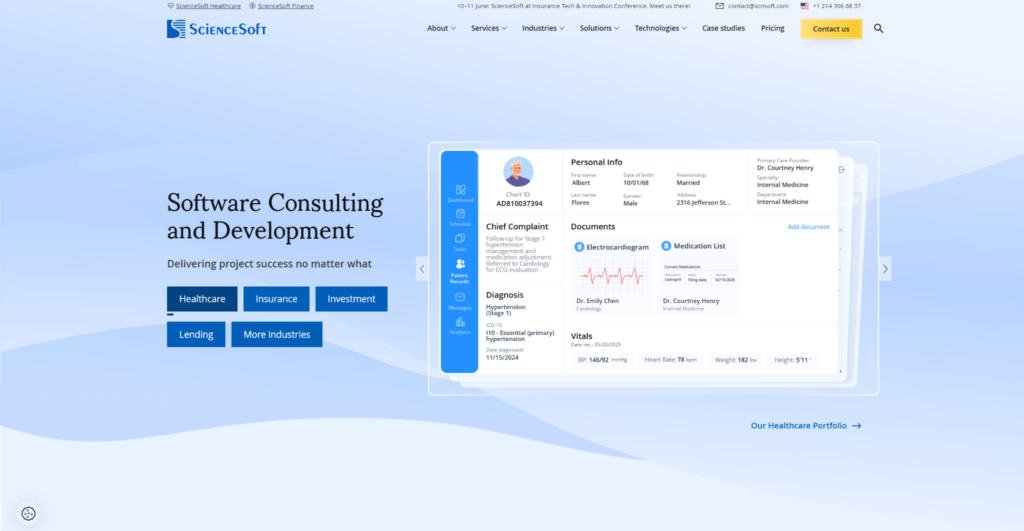
A software consulting and development company with 36 years of expertise that delivers end-to-end IT services to help clients achieve their digital transformation goals — that 1989 founding year isn’t just a vanity metric. It signals institutional memory navigating regulatory shifts across multiple banking eras. 750+ IT professionals, and a dedicated Architecture and Solutions Center of Excellence featuring nine principal architects with 15–25+ years of experience each, differentiate ScienceSoft from boutique shops that staff projects with mid-level generalists.
| Attribute | Value |
|---|---|
| Core BFSI services | Banking, insurance, lending, investment management, payment services, decentralized finance |
| Deliverables | Banking and mobile banking software, payment gateways, underwriting automation, loan management, investor portals, fraud detection, compliance software |
| Compliance focus | KYC/AML compliance solutions, RegTech |
| Scale advantage | 750+ IT professionals across 40 countries |
The firm develops custom banking apps, payment gateways, underwriting automation systems, loan management platforms, investor portals, insurance software, crypto wallets, and financial analytics solutions. Its expertise also covers AI-powered financial automation, fraud detection systems, compliance-focused software, and enterprise BFSI platforms designed to improve operational efficiency, security, and customer experience.
That breadth matters for banks modernizing multiple systems simultaneously — you’re not assembling a Frankenstein team from three vendors.
2. Softjourn
The go-to firm for payment processors and corporate card programs that need PCI-DSS compliant platforms without enterprise sticker shock.

Softjourn is a full-cycle software consulting and development company with deep expertise in custom financial platforms and fintech infrastructure development. Established in 2001 and headquartered in Ivano-Frankivsk, Ukraine, with additional offices in Poland and Brazil, Softjourn works primarily with clients in North America and the United Kingdom.
What sets them apart is 20+ years building financial software with 150+ FinTech projects delivered and 30+ published case studies — not vague claims but documented work covering payment processing and gateway development (PCI-DSS compliant; Stripe, Apple Pay, Interac, First Data, Worldpay, Secure Check), prepaid, gift card, and corporate card platforms (card issuing, loyalty, unbanked population enablement), core banking system development and modernization.
Their dedicated R&D practice (operating since 2008) supports FinTech innovation in AI-driven automation, fraud detection, and data platforms, which matters when you’re building payment systems that need to scale beyond MVP. Client roster includes PEX, UPC, Tacit, Bullet, SVB, PaySign, Viamericas, Versapay, CyberSource, Vanco Payments, Tribal Credit — recognizable names in prepaid cards and B2B payments. Industry recognition: IAOP Global Outsourcing 100 – multi-year listing since 2016, Inc. 5000 – listed in 2023, DesignRush – 2026 Top FinTech Software Development Companies listing.
- PCI-DSS / FDIC / SEPA audit preparation — critical for payment processors launching new card programs
- Buy Now Pay Later, installment payments, mobile wallets, eWallets development experience
- FinTech integrations (Mulesoft, Salesforce, banking APIs, card networks, KYC/AML, OFAC/CIP compliance)
- Multi-geography delivery model (Ukraine, Poland, Brazil offices) offers timezone flexibility for North American clients
3. Itransition
RegTech and compliance automation specialists — the firm banks call when KYC/AML requirements threaten launch timelines.
Pros:
- RegTech, KYC, and AML compliance solutions as documented core competency, not a bolt-on service
- Microsoft Partner since 2008 with 3,000+ seasoned developers across 40 countries — scale for multi-jurisdiction compliance builds
- Financial software solutions for banking, financial services, and insurance organizations (BFSIs) to help them establish effective and secure financial processes
Cons:
- Founded year listed as 1998, but not prominently featured in positioning — less emphasis on longevity than competitors
- Generic “top-rated software engineering company” tagline doesn’t convey fintech depth at first glance
Itransition is a global software engineering company with more than 25 years of experience delivering software solutions focused on automation, operational efficiency, and digital transformation. Founded in 1998, the company has experience building systems across several major technology cycles, including the rise of online banking, post-2008 financial infrastructure modernization, and the transition toward mobile-first financial services. Its portfolio includes lending and loan management platforms, wealth management systems, investment software, stock trading solutions, and cryptocurrency platforms.
The company also develops payment processing and billing systems, banking and mobile banking software, as well as financial analytics and BI tools. However, its strongest positioning comes from RegTech and compliance-focused development, including KYC and AML solutions designed for fintech companies entering regulated markets or financial institutions facing stricter compliance requirements. With more than 3,000 developers globally, Itransition has the scale to support large compliance-driven fintech projects and enterprise-level implementations.
4. RNDpoint
AI-first fintech builders — the firm payment processors and neobanks hire when fraud detection and conversational banking are table stakes, not future roadmap items.
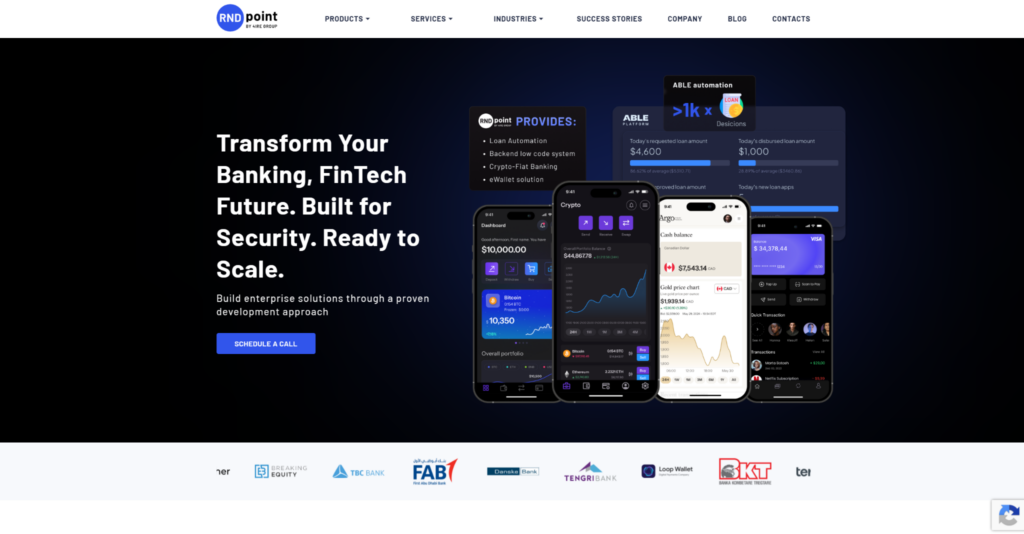
RNDpoint is a fintech software development company focused on building secure and scalable solutions for banks, payment providers, and fintech startups. The company works across areas such as AI-powered banking tools, fraud detection, enterprise financial platforms, and API-driven fintech infrastructure. With more than 250 specialists and over 11 years of market experience, RNDpoint provides full-cycle development services for both startups and established financial businesses.
Founded in 2014, the company represents a newer generation of fintech vendors built around mobile-first products, API-first ecosystems, and cloud-native architectures rather than traditional legacy banking systems. Compared to older enterprise-focused providers, RNDpoint positions itself more heavily around modern fintech infrastructure and AI-driven financial products.
- AI chatbot development, Generative AI development, AI fraud detection — not retrofitted AI but core service lines with 6+ years of specialized experience in Generative AI roll-out strategies across financial services
- AI agent development, AI copilot development for conversational banking use cases (account inquiries, payment initiation, spending analysis)
- Software integration services and API integration critical for connecting fraud models to payment rails without latency
- 250+ tech experts — mid-sized scale balances boutique attention with delivery capacity
RNDpoint delivers AI chatbot solutions grounded in strategic business alignment, not merely technical execution — that positioning matters because most banks buying AI don’t need more models, they need models that pass compliance review and integrate with existing KYC workflows. An AI chatbot for banking appears in their FAQ, signaling documented use cases, not speculative capability.
5. Euvic
Staff augmentation and infrastructure partner for fintech teams that need European engineering talent without spinning up a local entity.
| Attribute | Value |
|---|---|
| Service model | Staff Augmentation, Dedicated Teams, Outsourcing |
| Core capabilities | Software Development, IT Infrastructure, Marketplace Development |
| Geographic focus | Global access to a wide range of IT specialists with a European base |
| Culture fit | Created by IT engineers for IT engineers, culture centered around humility, transparency, and non-prestige |
Euvic provides a broad range of IT services that include software development, outsourcing, IT infrastructure, consulting, and digital transformation support. Its service model goes beyond pure fintech development, making the company relevant for financial institutions that need both infrastructure expertise and application development within a single vendor partnership.
The company also offers staff augmentation and dedicated engineering teams for businesses that require additional technical capacity without building large in-house departments. Euvic positions itself around engineering-driven delivery and flexible collaboration models rather than enterprise-style consulting structures, which may appeal to fintech teams looking for practical execution support instead of strategy-heavy engagements.
6. 10Pearls
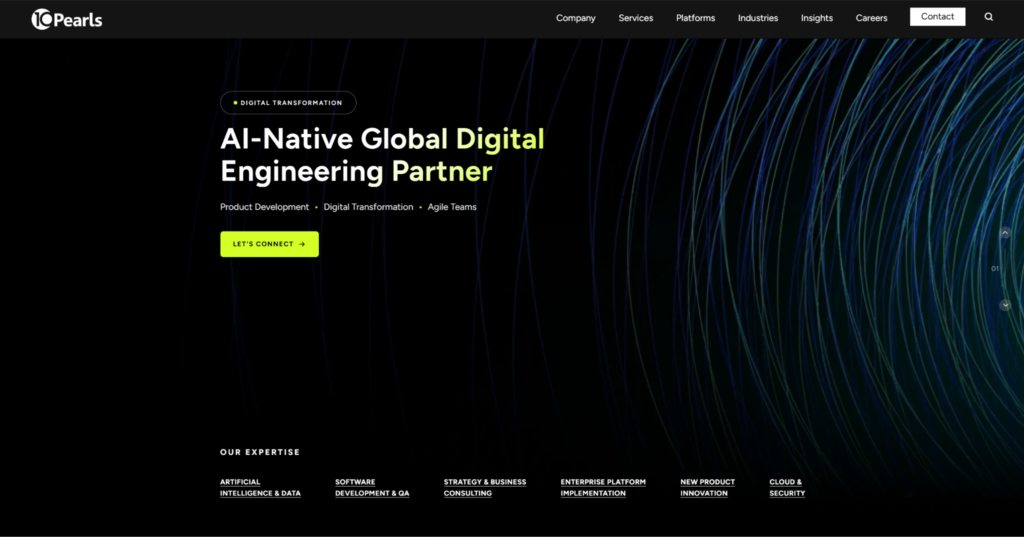
AI-native product engineering for fintech startups that need to ship fast without accruing technical debt — the firm VCs recommend when portfolio companies need adult supervision on MVP builds.
Pros:
- AI-Native Global Digital Engineering Partner that helps startups and enterprises compete in the digital age — explicit startup ICP fit
- 2004 founding balances longevity with modern stack fluency
- End-to-end delivery: Agile pods take full ownership of their work and have minimal external dependencies — the autonomous team model reduces coordination overhead
Cons:
- Generic “AI-native” positioning doesn’t convey fintech-specific depth — profile lacks payment or banking case language
- No published pricing or engagement models
10Pearls positions itself as an AI-focused digital product engineering company working with both startups and enterprise clients. The company emphasizes product strategy, rapid delivery, and cross-functional development teams, making it particularly relevant for fintech startups building MVPs, customer-facing applications, and AI-driven digital products.
Its delivery model is based on self-contained agile teams designed to reduce coordination overhead and accelerate development cycles. This approach allows projects to adapt more quickly to changing product requirements while maintaining faster iteration and release timelines compared to more traditional enterprise development structures.
Final Thoughts
No single firm on this list holds a universal “best” title—each occupies a distinct niche shaped by two decades of payment-system specialization, 35 years of enterprise IT transformation, regulatory compliance engineering depth, AI-first fraud detection architecture, Central European nearshore delivery models, or venture-backed product acceleration frameworks. The right partner emerges from matching your constraint hierarchy—regulatory burden, legacy system complexity, speed-to-market pressure, budget elasticity—to the operational DNA these firms have spent years crystallizing.